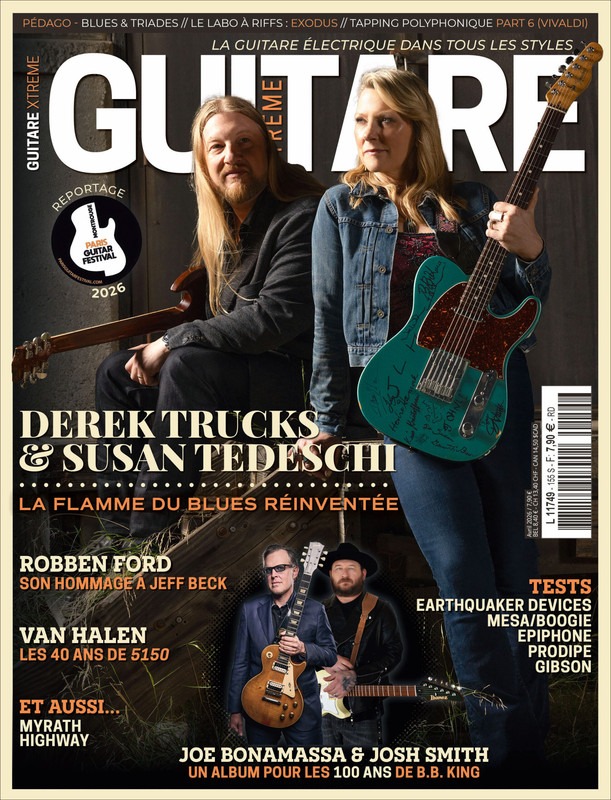
Topics › All Forums › General › The Corner Pub › Guitare Xtreme Magazine # 155

| March 27, 2026 at 10:51 am Quote #70197 | |
 ron (12475) | [via Google Translate] https://guitarextrememag.com/produit/numero-155/ ronQuote |
| April 30, 2026 at 5:13 pm Quote #70337 | |
| ron (12475) | [via Google Lens Translate] 5150: How to reinvent your band? Two years ago, we celebrated the fortieth anniversary of the release of 1984, an album all the easier to love because it’s the album of the elephantine hit “Jump,” and above all, the swan song of the David Lee Roth version of the band. Can we now celebrate the fortieth anniversary of its successor, 5150, in 2026 without salvaging it after the departure of the long-time frontman? A look back at a lesson in reinvention. 1984 was the year of the definitive consecration of a band that, better than any other, captured the sex, coke, alcohol, and rock ‘n’ roll vibe of the 80s, with its inevitable counterpart: AIDS, heroin, depression, and grunge, which balanced everything out in the long hangover of the 90s. Van Halen embodies fun, sunshine, and Californian optimism, led by a duo that perfectly embodies the yin and yang of great rock bands. Like Mick Jagger or Steven Tyler, David Lee Roth is a frontman who lives for the limelight, who goes all out and sees his role as master of ceremonies as a true mission. For his part, Eddie shines far more for his immense musical talent than for his exuberant personality. Like Jimmy Page or Joe Perry, Eddie never goes near a microphone and fully embraces his role as the great architect who designs the albums in the singer’s shadow Except that in 1985, after a grueling tour (106 dates in 1984), Roth longed for freedom. He released an EP of covers accompanied by the cream of the crop of session musicians, Crazy From The Heat (a name that would later become a track on his first full-length solo album), and is working on a film project with Pete Angelus, who was already responsible for the visuals for Van Halen (the project will not come to fruition). Since the recording of 1984, Eddle has had its own studio called 5150, named after the California police code responding to a subject suffering from an illness requiring hospitalization. Moreover, to polish this name, the group will choose to use straitjackets for the photos in album 5150 So, Eddie is in his studio, enjoying the temporal freedom afforded by a creative space that isn’t rented by the hour, where one can meticulously choose each element of one’s own equipment. Frank Zappa’s Utility Mill Research Kitchen was inspired by this approach, and, like him, Eddie chain-smokes while recording songs. The early years at Studio 5150 correspond to a period of unprecedented inspiration for the guitarist, who is therefore all the more frustrated at having to compose without Roth’s voice. As a result, he calls upon singers who simply lend their voices to the demos. But even if these recordings aren’t intended for public release, the symbolism is significant: it’s a way for Eddie to show Roth that he can perfectly well do without him to move forward, and this is the straw that breaks the camel’s back in a cup already overflowing with mutual resentment….. RENAISSANCE From then on, Van Halen had to find a new frontman. Not just a singer, but someone who could handle being front and center. Worse: someone who would have to take the place of the original frontman after the most acclaimed album of the original lineup. Historically, very few bands have managed to solve this equation, this doomed gamble, whether it’s Iron Maiden without Bruce Dickinson or Judas Priest without Rob Halford, whose albums without the original frontman were all steps toward the inevitable return of the real singer. There was Brian Johnson with AC/DC, but Bon Scott wasn’t going to come back anyway Several options were considered, including the singer from the band Scandal, which would have been an interesting choice given the underlying machismo in Van Halen, and Daryl Hall, from the duo Hall & Oates, a possibility that clearly shows Eddie was looking for a singer with a soulful voice rather than a typical hard rock one. But in the end, it was Sammy Hagar who landed the job. The connection wasn’t new, since Van Halen’s longtime producer, Ted Templeman, had already produced the first two albums of the band Montrose with Hagar on vocals, two albums that profoundly influenced Eddie. It’s not said often enough, but guitarist Ronnie Montrose was largely responsible for the “brown sound.” We already find in his playing that big, undoubled Les Paul sound through a Marshall amp that would define the rhythm section of early Van Halen, and even some of his playing techniques—listen to the wild vibrato in the intro to “Bad Motor Scooter” and try to tell me you don’t hear the beginnings of the dive bombs on “Eruption.” To top it all off, Hagar had just released his most popular solo album, VOA, in 1984, featuring the famous single “I Can’t Drive 55,” giving him even more credibility with fans. And it must be said that 5150 is a very good album, perhaps even more cohesive than its predecessor. Hagar is a soul singer, with a thicker timbre than Roth, and he’s certainly not lacking in talent. But track after track, the impression grows that we’re listening to a diminished version of the band, where established and expected patterns follow one another without any real surprises. “Good Enough” bridges the gap between Hagar and Roth with a typical vocal ad-lib on the bridge, “Get Up.” is a turbo boogie à la Hot For Teacher, Love Walks In is unbearably saccharine, and Dreams sounds too much like Jump to be honest. There are some real successes, though: Why Can’t This Be Love is a very good track, and the intro to Summer Nights shows that Eddie has a knack for refreshing his bag of gadgets and tricks (here with the TransTrem vibrato on his Steinberger). The 1986 tour is also interesting to observe from this perspective of the band’s reinvention. As seen in the Live Without A Net concert (released on VHS at the time and reissued on Blu-ray with the 5150 anniversary box set), Hagar sets the tone right from the start by playing guitar on stage (a red Jackson Randy Rhoads, no less), and he’s even alone on guitar while Eddie plays keyboards on “Why Can’t This Be Love.” But the setlist is particularly noteworthy: most of the tracks come from 5150, there are only two tracks from the Roth era, and two solo Hagar songs! A great way to establish that Van Hagar is a new band, a new era, the finally free realization of Eddie Van Halen’s artistic vision, who, like the Atlas on the album cover, now carries the weight of the band alone Roth would eventually return, after four successful Van Hagar albums, though their sound hasn’t necessarily aged very well. But the band would never again find such a desire to reclaim their crown, on their own terms, as with 5150. And for that reason alone, this album deserves a second listen. ronQuote |
You must be logged in to reply to this topic.